What is the Difference Between Inverter AC and Non-Inverter AC?
Confused between inverter and non-inverter AC? Compare cooling, power consumption, cost, and performance, and get expert AC service from Sahil Service.
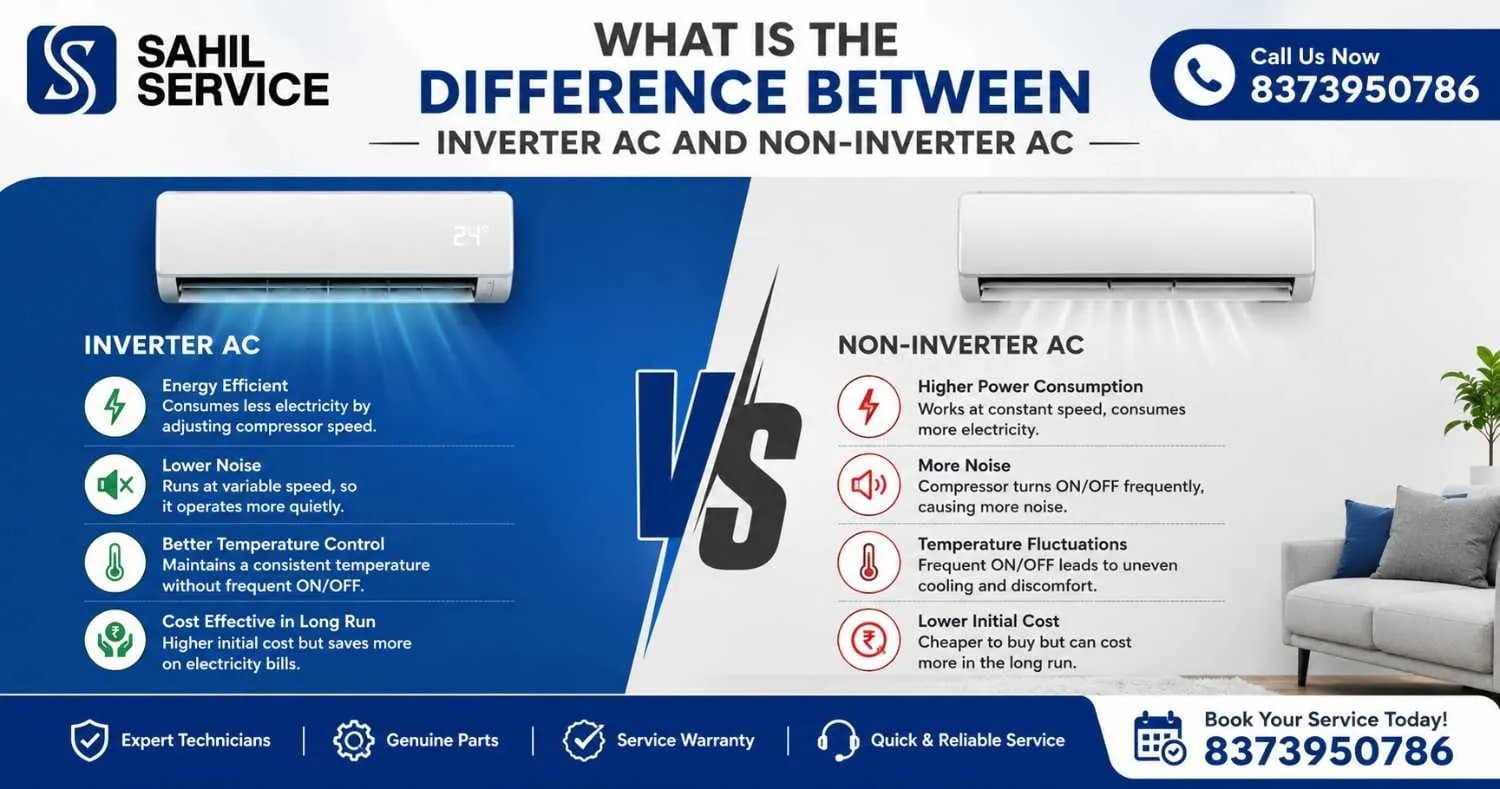
Inverter AC and Non-Inverter AC? Which One Should You Buy in 2026?
Buying a new air conditioner isn't as simple as choosing a brand or tonnage anymore. One of the biggest decisions you'll make is whether to buy an inverter AC or non-inverter AC.
Although both are designed to cool your room, they work differently and can have a noticeable impact on your electricity bills, comfort, and long-term maintenance costs.
Many buyers search online for terms like inverter AC vs non inverter AC, inverter air conditioner vs non inverter, or difference between inverter AC and normal AC because they want to know which option offers better value.
The answer depends on how often you use your AC, your budget, and your expectations for energy efficiency.
In this guide by Sahil Service, we'll explain everything in simple language from compressor technology and electricity consumption to cooling performance, maintenance, and real-world usage so you can confidently choose the right air conditioner for your home or office.
What is an Inverter AC?
An inverter AC is an air conditioner that uses variable-speed compressor technology. Instead of switching the compressor completely ON and OFF, it continuously adjusts the compressor speed according to the room temperature.
When you switch on the AC, the compressor initially runs at high speed to cool the room quickly. Once the desired temperature is reached, it slows down and keeps maintaining that temperature without repeatedly stopping.
This is the main reason why an inverter AC consumes less electricity and provides more consistent cooling than a traditional air conditioner.
Benefits of an Inverter AC
- Low electricity bill
- Fast cooling
- Same room temperature
- Less noise
- Long compressor life
- More comfort for long use
What is a Non-Inverter AC?
A non-inverter AC, often called a normal AC, uses a fixed-speed compressor. Unlike an inverter model, the compressor can only operate at one speed.
Once the room reaches the set temperature, the compressor turns OFF completely. When the temperature rises again, it restarts at full power.
This repeated ON-OFF cycle is the biggest difference between normal AC and inverter AC, and it affects both energy consumption and cooling comfort.
Although a non-inverter AC is usually more affordable to purchase, it generally consumes more electricity when used for long hours.
Advantages of a Non-Inverter AC
- Low buying price
- Simple compressor
- Low repair cost
- Good for less use
How Does an Inverter AC Work?
Many people assume an inverter AC works with a home power inverter. That's a common misconception.
The term "inverter" refers to the technology that controls the compressor motor. Instead of running at one fixed speed, the compressor automatically increases or decreases its speed depending on the cooling demand.
Because the compressor doesn't restart every few minutes, it avoids unnecessary power spikes and improves energy efficiency.
How Does a Non-Inverter AC Work?
A non-inverter AC follows a much simpler operating cycle.
The compressor runs at full speed until the desired temperature is reached. It then switches OFF completely. As the room becomes warmer, the compressor turns ON again and repeats the process.
This continuous start-stop operation leads to:
- Uses more electricity
- Small changes in room temperature
- Compressor wears out faster
- More compressor noise
What is the Difference Between Inverter AC and Non-Inverter AC?
The biggest difference between inverter and non inverter AC lies in how the compressor operates.
If you're comparing inverter AC versus non inverter AC :
| Feature | Inverter AC | Non-Inverter AC |
| Compressor | Variable Speed | Fixed Speed |
| Cooling | Continuous & Smooth | ON/OFF Cooling |
| Electricity Consumption | Lower | Higher |
| Temperature Control | More Stable | Fluctuates |
| Noise Level | Quiet | Louder During Restart |
| Initial Cost | Higher | Lower |
| Running Cost | Lower | Higher |
| Best For | Daily Use | Occasional Use |
Which AC Consumes Less Electricity?
One of the most common questions homeowners ask is about 1.5 ton inverter AC vs normal AC power consumption.
An inverter AC typically uses less electricity because it regulates compressor speed instead of repeatedly restarting. In contrast, a normal AC consumes more power due to frequent compressor start-ups, especially during extended use.
If you run your AC for six to eight hours every day, an inverter model can significantly reduce your monthly electricity bill over time.
Which AC Cools Fast?
When comparing inverter AC vs normal AC, cooling speed is another important factor.
An inverter AC generally cools a room fast because its compressor initially operates at maximum capacity before slowing down to maintain the set temperature.
A non-inverter AC also cools effectively, but it cannot adjust compressor speed once it's running.
Which AC Offers Better Comfort?
Comfort isn't just about how cold the room becomes. It also depends on how consistently the AC maintains the temperature.
Since an inverter AC continuously adjusts its cooling output, it avoids sudden temperature changes. This results in a more comfortable indoor environment.
A non-inverter AC, on the other hand, creates noticeable temperature fluctuations because the compressor keeps switching ON and OFF.
Which AC Makes Less Noise?
Because the compressor in an inverter AC operates smoothly at different speeds, it produces less noise.
A normal AC makes a noticeable sound every time the compressor restarts, making inverter models the preferred choice for bedrooms and offices.
Which AC Costs More?
The upfront price of an inverter AC is generally higher than that of a non-inverter model.
However, lower electricity consumption often offsets the additional investment over the years, making inverter ACs more economical for regular users.
What is the Difference Between Inverter AC and Split AC?
Many buyers confuse these terms.
A split AC describes the design of the air conditioner, while inverter describes the compressor technology.
A split AC can be either an inverter AC or a non-inverter AC. Therefore, comparing the difference between inverter AC and split AC is not technically correct because they refer to different features.
What is the Difference Between Inverter and Dual Inverter AC?
Another common question is the difference between inverter and dual inverter AC.
A dual inverter AC uses two rotary compressors instead of one.
This allows it to deliver:
- Fast cooling
- Less noise
- Saves electricity
- Less vibration
- Long compressor life
Although dual inverter models cost more, they are ideal for users seeking maximum comfort and energy savings.
Inverter AC vs Non-Inverter AC: Which One Should You Buy?
If you're still deciding between an inverter AC and non inverter AC, your choice should depend on your usage pattern.
Choose an inverter AC if you:
- Use the AC every day
- Run it for more than 5–6 hours
- Want lower electricity bills
- Prefer quieter operation
- Plan to use the AC for many years
Choose a non-inverter AC if you:
- Use the AC occasionally
- Have a limited budget
- Need cooling for a guest room
- Want a lower initial purchase price
What is the Price Difference Between an Inverter AC and a Non-Inverter AC?
One of the biggest factors when choosing between an inverter AC and non-inverter AC is the price. While inverter models usually cost more initially, they often help reduce electricity bills over time, making them a better long-term investment.
Here's a general price comparison for 2026.
| AC Type | Approximate Price Range |
| 1 Ton Non-Inverter AC | ₹26,000 – ₹34,000 |
| 1 Ton Inverter AC | ₹31,000 – ₹42,000 |
| 1.5 Ton Non-Inverter AC | ₹30,000 – ₹40,000 |
| 1.5 Ton Inverter AC | ₹35,000 – ₹52,000 |
| 2 Ton Non-Inverter AC | ₹40,000 – ₹50,000 |
| 2 Ton Inverter AC | ₹45,000 – ₹65,000 |
How Much Does AC Installation Cost?
Buying an AC is only part of the total cost. Professional installation ensures better cooling, improved efficiency, and a longer lifespan.
According to the latest Sahil Service price list, installation charges are:
| Service | Starting Price |
| Split AC Installation | ₹1,499 |
| Window AC Installation | ₹699 |
| Split AC Uninstallation | ₹599 |
| Window AC Uninstallation | ₹399 |
How Much Does AC Maintenance Cost?
Whether you own an inverter AC or a normal AC, regular servicing helps maintain cooling performance and prevents expensive repairs.
Sahil Service AC Service Price List:
| AC Service | Price |
| Split AC Service | ₹499 |
| Lite AC Service | ₹499 |
| Split AC Foam Jet Service | ₹999 |
| Window AC Foam Jet Service | ₹399 |
| AC Gas Refill | ₹2,700 |
| 2 Ton AC Gas Refill | ₹3,500 |
What Are the Common Repair Costs for an Inverter AC?
Since inverter ACs use advanced electronics, some repairs can cost more than non-inverter models.
| Repair Service | Starting Price |
| Inverter PCB Repair | ₹5,000 |
| Non-Inverter PCB Repair | ₹1,500 |
| Sensor Replacement | ₹849 |
| Contactor Replacement | ₹999 |
| Universal Remote | ₹800 |
| Stabilizer Repair | ₹1,500 |
Why Choose Sahil Service for AC Installation and Maintenance?
No matter whether you choose an inverter AC or a non-inverter AC, Expert installation and regular servicing play a crucial role in ensuring efficient cooling, lower electricity bills, and a longer compressor lifespan.
At Sahil Service, our certified technicians provide expert AC installation, repair, gas refilling, deep cleaning, and preventive maintenance for all major brands. With transparent pricing, doorstep service, and a commitment to quality, we help you get the best performance from your air conditioner throughout the year.
Book your AC service with Sahil Service App today and enjoy Trusted, Energy-saving cooling in every season.
Our Services Areas in Delhi NCR
AC Repair Service in Badarpur Border | AC Repair Service in Sarita Vihar | AC Repair Service in Saket | AC Repair Service in Tughlakabad | AC Repair Service in Mehrauli | AC Repair Service in Vasant Kunj | AC Repair Service in Malviya Nagar | AC Repair Service in Palam | AC Repair Service in Hauz Khas | AC Repair Service in Kalkaji | AC Repair Service in Gurgaon | AC Repair Service in Ghaziabad | AC Repair Service in Noida | | AC Installation Service in Delhi | AC Repair in Laxmi Nagar Delhi | Ac Service in sector 37 | Ac Service in Green Field | Ac Service in Nehar Par Faridabad | Ac Service in Meethapur
Frequently Asked Questions
Find answers to common questions about this article