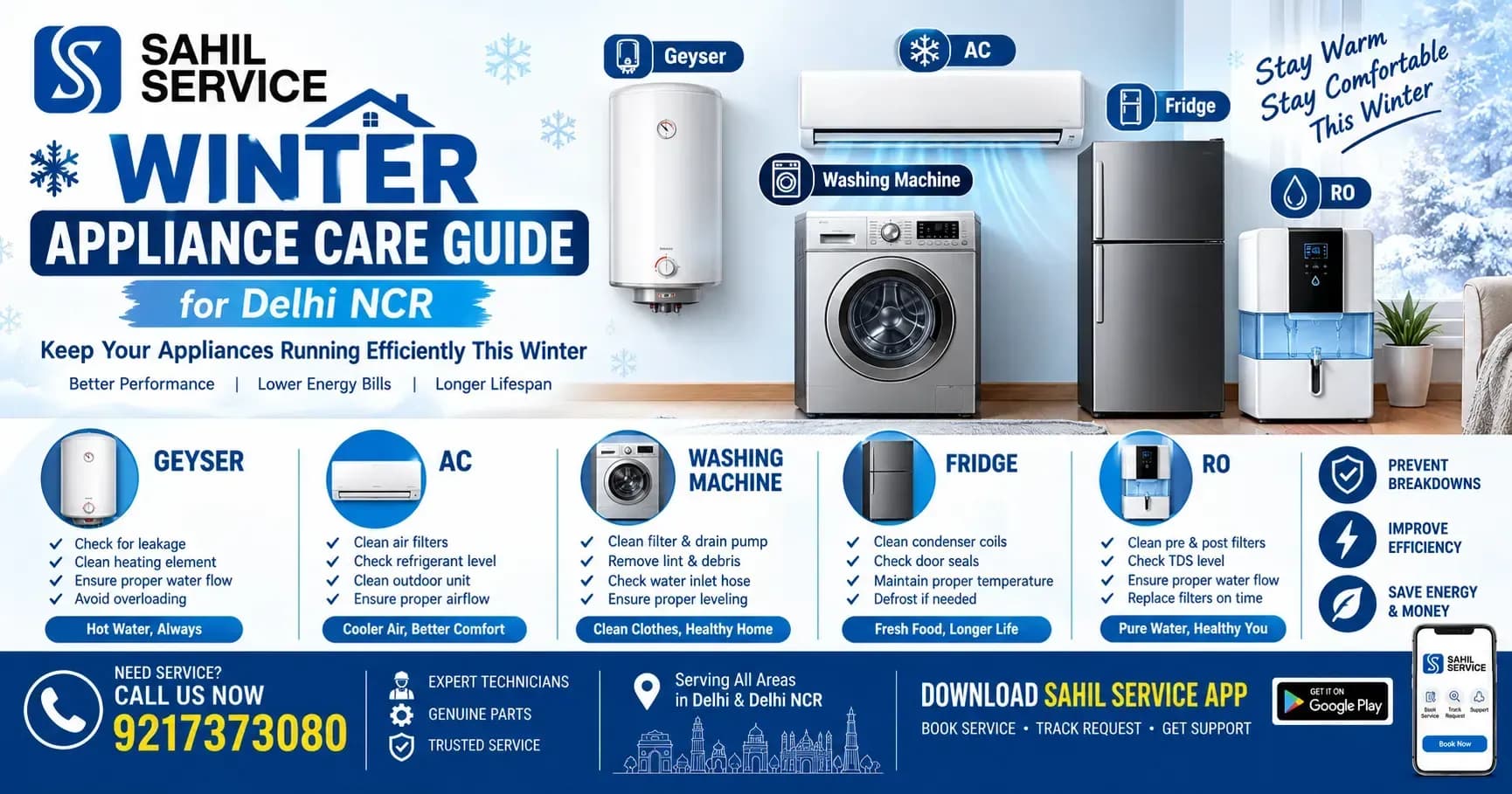
The first cold morning is a bad time to find out your geyser has stopped heating. Winter puts a different kind of load on your home appliances, and most winter breakdowns give small warnings weeks in advance. This guide shows you what to check now, what you can safely do yourself, and when to call a technician.
Quick summary: Service your geyser and AC before the cold peaks, never overload the washing machine with quilts, adjust your fridge setting for cooler weather, and change RO filters on schedule. Servicing early is cheaper and less stressful than repairing in a rush.
1. Geyser: the appliance that matters most
A geyser works hardest from November to February, and Delhi NCR's hard water makes it worse. Mineral scale slowly coats the heating element, so the geyser takes longer to heat and uses more electricity. Left alone, the element can eventually burn out.
Signs your geyser needs attention
- Water takes noticeably longer to heat than last winter.
- Water is only lukewarm even though the indicator light is on.
- The MCB trips whenever the geyser switches on.
- You hear cracking, rumbling or popping sounds while heating.
- There is dampness or a drip near the fittings, the pipes or the base.
- The water smells or looks rusty or cloudy.
Safety first: Water and electricity are a dangerous mix. If your geyser sparks, gives a mild shock, leaks near wiring or trips the MCB repeatedly, switch it off at the mains and do not open it yourself. Call a technician.
What you can do safely
Check that the thermostat dial is set to a sensible level, confirm the power supply and MCB are on, and look for visible leaks. That is where DIY should stop. A yearly check-up that includes cleaning scale, testing the thermostat and inspecting the safety valve and earthing is the best protection for the geyser and for your family.
Geyser acting up? Get it checked before the cold sets in.
Book a Geyser Check-up2. AC in winter: heating mode and pre-season care
Many households in Delhi NCR use an AC for both cooling and heating. Before you rely on it for warmth, understand one basic point: only hot-and-cold (heat pump) models can heat a room. A cooling-only AC has no heating mode, and its remote may show a heat symbol that does nothing. Check your model's manual if you are unsure.
If your AC has heating mode but is not warming the room
- Dirty filters after months of summer use and dusty autumn air choke airflow and reduce heating.
- Low refrigerant from a slow gas leak affects heating as well as cooling.
- Outdoor unit problems such as blocked coils or a weak fan reduce heat output.
- Wrong settings: confirm the mode is set to heat and the set temperature is above the room temperature.
If you are not using your AC this winter
Do not just switch it off and forget it. Clean the filters, cover the outdoor unit so dust and debris stay out, and switch off the power at the MCB. A jet-pump deep service before the season ends makes the spring restart much easier, because dust and moisture left inside a stored AC can lead to odours and poor cooling next summer.
3. Washing machine: quilts, hard water and drainage
Winter laundry means blankets, quilts, sweaters and jackets. These heavy, water-absorbing items are the most common reason washing machines start shaking, walking across the floor or stopping mid-cycle.
- Do not overload. One quilt or a couple of blankets per wash is safer than stuffing the drum. An unbalanced load stresses the drum bearings and suspension.
- Watch drainage. Lint and stray socks or coins can block the drain pump filter. If water is left in the drum after a cycle, the drain path is the first thing to check.
- Use the right amount of detergent. Cold water dissolves powder more slowly, and excess detergent leaves residue and can cause the machine to run extra rinse cycles.
- Inspect the inlet hose and filter for scale, which reduces water pressure and can trigger an error code.
If the machine makes grinding noises, will not spin, or shows repeated error codes, stop using it and book a check-up. Continuing to run it can turn a small repair into a costly one.
4. Refrigerator: cold weather quirks
Your fridge works less hard in winter because the room is cooler, and some settings that worked in summer can cause problems now.
- Food freezing in the main compartment: the thermostat setting is often too cold for the season. Turn it down one notch and observe for a day or two.
- Frost build-up: check that the door gasket seals completely and the door is not being left ajar. A worn gasket lets in warm, moist air that turns to frost.
- Water pooling at the bottom: a blocked drain hole is the usual cause and is worth a quick clean.
- Weak cooling despite normal settings: if the compressor runs constantly and the fridge is still not cold, it may point to a gas leak or a faulty component. That needs a professional.
5. RO water purifier: slow flow in cold weather
Many people notice that their RO produces water more slowly in winter. Colder incoming water can reduce membrane output, so a modest slowdown is normal. A sharp drop, a strange taste, or a full storage tank that empties quickly is not normal and usually means it is time for a filter change or membrane check.
Follow the service interval in your purifier's manual, and do not stretch filter life to save money. Overused filters can let water quality slide, and a clogged membrane strains the pump.
6. Microwave: heavy winter use
Reheating meals happens more often in winter, so your microwave gets more use. Keep the interior clean, because food splatter can burn and cause sparks. Never run it empty, and stop using it if the door does not close properly, the turntable stops rotating, or it heats unevenly or not at all. A door seal problem is a safety issue and worth having checked.
Not sure which appliance needs attention first? Tell us what is going wrong and our team will guide you.
Contact Sahil Service7. The 10-minute winter checklist
Print this out or save it to your phone, and go through it once a season.
- Geyser heats water in a normal time, with no leaks or unusual noises
- MCB does not trip when the geyser or heater is on
- AC filters cleaned, or the outdoor unit covered if the AC is not in use
- Washing machine drain filter is clear and hoses are free of scale
- Fridge thermostat suits the cooler weather and the door gasket seals well
- RO filter change date is checked against the manual
- Microwave interior is clean and the door closes firmly
- Plugs, sockets and extension boards feel cool and are not scorched or loose
Quick reference: DIY or professional?
| Problem | Try first | Call a technician if |
|---|---|---|
| Geyser not heating | Check power, MCB and thermostat setting | It still does not heat, trips the MCB, or leaks |
| AC not warming | Confirm heat mode, clean filters | Airflow is fine but there is still no heat |
| Washing machine shaking | Reduce the load, level the machine | Noise or shaking continues on a normal load |
| Fridge freezing food | Lower the thermostat one notch | The problem continues after adjusting |
| RO flow is low | Check the filter date and the inlet supply | Flow stays low after a filter change |
| Microwave sparking | Clean the interior, remove metal items | Sparks continue or the door will not seal |
Why early servicing beats emergency repair
Service demand tends to rise when the weather turns, and technicians get busy. Booking a check-up before the cold peaks gives you a wider choice of time slots and lets you fix a small fault before it stops the appliance completely. Sahil Service covers Delhi, Noida, Greater Noida, Gurgaon, Faridabad and Ghaziabad, and repairs come with a 30-day service warranty.
Get your home winter-ready. One message is all it takes to book a visit.
Book Your Winter Service NowHave a question that is not covered here?
Talk to Our TeamThis guide offers general information to help you maintain your appliances. Every model is different, so follow your manufacturer's manual and let a qualified technician handle any electrical or gas-related work. Repair timelines and outcomes depend on the appliance and the fault.