How Much Electricity Does a Geyser Consume? Daily and Monthly Cost Explained
Find out how much electricity a geyser consumes per day and month. Learn geyser power consumption, electricity costs and ways to save energy
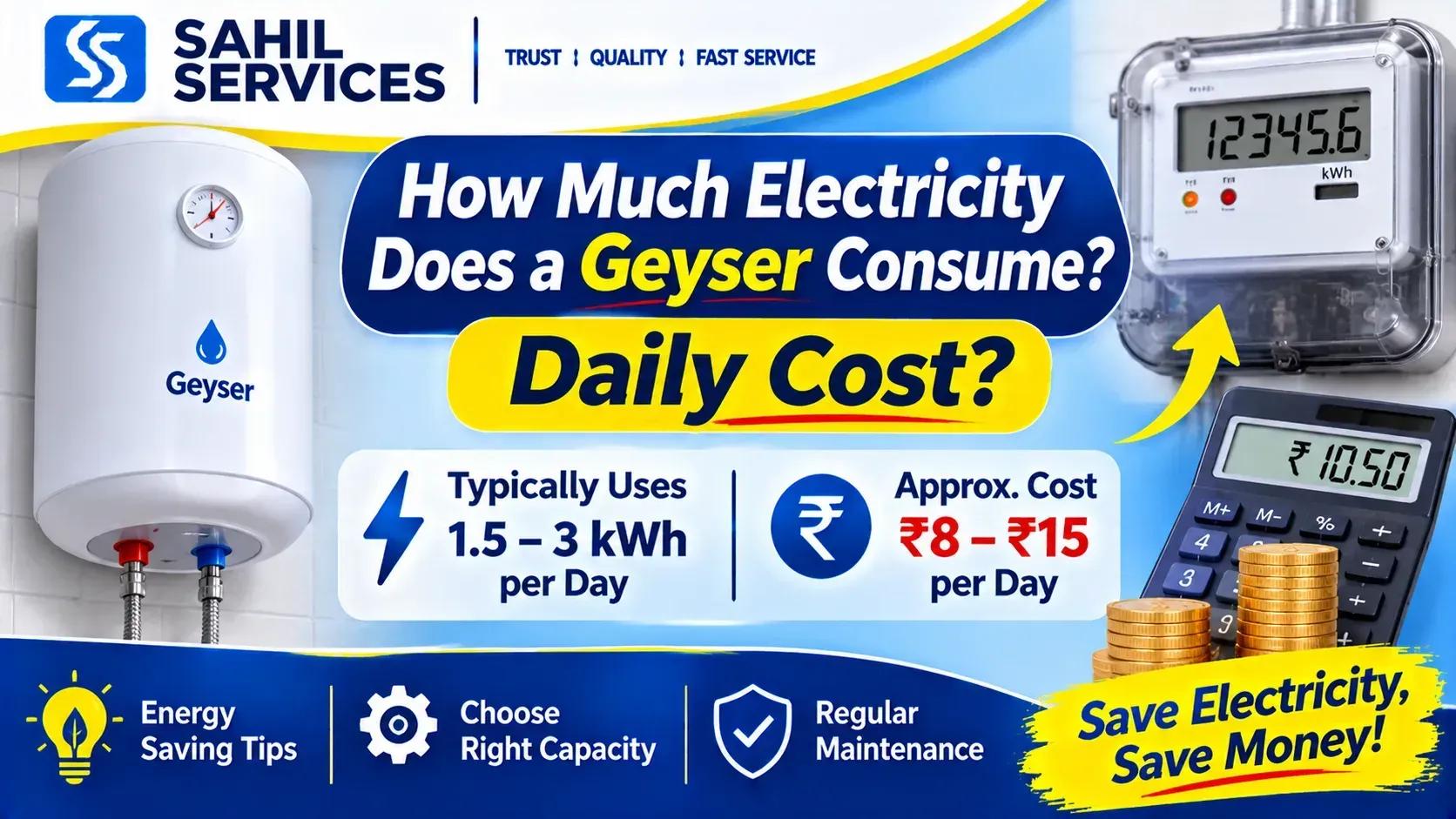
Have you ever noticed that your electricity bill increases during winter, even when you haven't changed your daily routine? Your geyser could be one of the reasons.
During colder months, using hot water becomes part of everyday life. Whether you are taking a morning shower, bathing children or washing utensils, an electric geyser makes daily tasks more comfortable. However, many homeowners don't realise how much electricity their geyser actually consumes.
Questions like "How many units does a geyser consume per hour?", "How much electricity does a 15-litre geyser use?" and "How can I reduce my geyser electricity bill?" are common among people trying to manage their household expenses.
The good news is that understanding geyser power consumption is not difficult. With a little knowledge about wattage, heating time and daily usage, you can estimate your electricity expenses and avoid unnecessary power consumption.
In this guide, we will explain how much electricity different geysers consume, how to calculate daily and monthly running costs, and practical ways to save electricity without compromising your comfort.
How Much Electricity Does a Geyser Consume?
The electricity consumption of a geyser mainly depends on its wattage, tank capacity, water temperature, insulation and how frequently you use it.
Most household electric geysers have a power rating between 1,500 watts and 3,000 watts, although some models may have different ratings.
For example:
- A 1,500-watt geyser consumes 1.5 units per hour of active heating.
- A 2,000-watt geyser consumes 2 units per hour of active heating.
- A 3,000-watt geyser consumes 3 units per hour of active heating.
One electricity unit is equal to one kilowatt-hour (kWh).
However, this does not mean your geyser consumes electricity continuously whenever it is switched on. Storage geysers generally stop heating once the water reaches the temperature selected on the thermostat. The heating element may switch on again when the stored water cools down.
Therefore, actual electricity consumption depends on how long the heating element operates.
How to Calculate Geyser Electricity Consumption?
If you want to calculate how much electricity your geyser uses, you can follow a simple formula.
Electricity Consumption = Geyser Wattage ÷ 1,000 × Active Heating Hours
Let's understand this with an example.
Suppose you have a 2,000-watt geyser.
- Geyser power: 2,000 watts
- Power in kilowatts: 2 kW
- Active heating time: 1 hour
- Electricity consumption: 2 units
This means a 2,000-watt geyser consumes approximately 2 electricity units when its heating element operates continuously for one hour.
If you use the same geyser for only 30 minutes of active heating, it will consume approximately 1 unit.
Geyser Electricity Consumption Per Hour
Here is a simple comparison of electricity consumption according to geyser wattage.
| Geyser Wattage | Units Per Hour | Units in 30 Minutes |
|---|---|---|
| 1,000 Watts | 1 Unit | 0.5 Units |
| 1,500 Watts | 1.5 Units | 0.75 Units |
| 2,000 Watts | 2 Units | 1 Unit |
| 2,500 Watts | 2.5 Units | 1.25 Units |
| 3,000 Watts | 3 Units | 1.5 Units |
These figures represent continuous active heating, not guaranteed real-world consumption.
How Much Does a Geyser Cost Per Day?
The daily electricity cost of a geyser depends on three important factors:
- The wattage of your geyser.
- The total active heating time.
- Your electricity price per unit.
For example, let's assume you have a 2,000-watt geyser and your electricity tariff is ₹8 per unit.
If the geyser's heating element operates for 30 minutes daily:
- Electricity consumption: 1 unit
- Electricity price: ₹8 per unit
- Daily running cost: ₹8
If the heating element operates for one hour daily:
- Electricity consumption: 2 units
- Electricity price: ₹8 per unit
- Daily running cost: ₹16
This is a simple way to estimate how much electricity your geyser adds to your daily expenses.
Estimated Daily and Monthly Geyser Electricity Cost
The following table assumes an electricity tariff of ₹8 per unit and 30 days of usage.
| Active Heating Time | Daily Units | Daily Cost | Monthly Cost |
|---|---|---|---|
| 15 Minutes | 0.5 | ₹4 | ₹120 |
| 30 Minutes | 1 | ₹8 | ₹240 |
| 45 Minutes | 1.5 | ₹12 | ₹360 |
| 1 Hour | 2 | ₹16 | ₹480 |
| 1.5 Hours | 3 | ₹24 | ₹720 |
| 2 Hours | 4 | ₹32 | ₹960 |
Important: These are illustrative calculations based on active heating time. Actual consumption can differ depending on water temperature, insulation, thermostat settings, standby losses and household usage. Your final electricity bill may also depend on applicable tariff slabs and fixed charges.
How Much Electricity Does a 15-Litre Geyser Consume?
A 15-litre geyser is commonly used in smaller bathrooms and households where moderate hot water requirements are sufficient.
However, its electricity consumption does not depend on tank capacity alone. The heating element wattage, incoming water temperature and desired temperature also matter.
For example, consider a 15-litre geyser with a 2,000-watt heating element.
If the element operates for 20 minutes:
2 kW × 20/60 hours = approximately 0.67 units.
At ₹8 per unit, the heating cost would be approximately ₹5.36.
This is an illustrative estimate. The actual time and electricity required to heat a full tank will vary according to the temperature of incoming water and the geyser's efficiency.
How Much Electricity Does a 25-Litre Geyser Consume?
A 25-litre geyser is generally suitable for households that need a larger quantity of hot water.
Since it heats more water than a 15-litre model, it may require more energy for a complete heating cycle when other conditions are similar.
For example, if a 25-litre geyser has a 2,000-watt heating element and operates for 30 minutes, it consumes approximately:
2 kW × 0.5 hours = 1 unit.
At ₹8 per unit, the estimated heating cost is ₹8.
Remember that a larger geyser does not automatically mean a much higher electricity bill. Your daily water requirements and heating habits play an important role.
What Factors Increase Geyser Electricity Consumption?
Sometimes, homeowners notice that their electricity bills are increasing even though their geyser usage has not changed significantly.
There can be several reasons behind this problem.
1. Faulty Geyser Heating Element
The heating element is responsible for warming the water inside the tank. When it develops scaling, damage or other faults, the geyser may take longer to heat water or may stop heating properly.
In areas with hard water, mineral deposits can accumulate around the heating element and affect heat transfer.
If your geyser takes unusually long to heat water, professional inspection may be necessary.
2. Faulty Thermostat
A thermostat controls the water temperature inside your geyser.
If it is not working correctly, the heating element may not switch off at the appropriate temperature. This can result in unnecessary heating and increased energy consumption.
A faulty thermostat should be inspected and replaced by a qualified technician when necessary.
3. Poor Tank Insulation
Storage geysers are designed to retain hot water through insulation.
When insulation becomes less effective, the stored water may lose heat more quickly. The heating element may then switch on more frequently to maintain the selected temperature.
This can increase electricity consumption over time.
4. Continuous Geyser Usage
Keeping a geyser switched on throughout the day is generally unnecessary for households that need hot water only during specific periods.
Although the thermostat controls heating, storage geysers can experience standby heat losses.
Switching the geyser off when hot water is not required for extended periods can help reduce unnecessary electricity consumption.
5. Mineral Deposits Inside the Geyser Tank
Hard water contains minerals that can settle inside the geyser tank and around its heating element.
Over time, these deposits may affect heating performance and contribute to unusual noises, slow heating and other operating problems.
Periodic inspection and cleaning, where recommended by the manufacturer, can help maintain the appliance.
How to Reduce Geyser Electricity Consumption?
You do not need to stop using hot water to control your electricity bill. A few simple habits can help you avoid unnecessary energy consumption.
1. Switch On the Geyser When Required
If you use hot water mainly in the morning, avoid keeping the geyser switched on throughout the day.
Switch it on according to your household's hot water requirements and turn it off when it is no longer needed.
2. Choose the Right Geyser Capacity
A geyser should match your family's hot water requirements.
For example, a smaller household may not need a very large storage tank. Choosing an appropriate capacity can help avoid heating more water than necessary.
3. Avoid Setting Extremely High Temperatures
Use a suitable temperature setting according to your requirements and the manufacturer's instructions.
Unnecessarily high temperature settings can increase energy requirements and may create a scalding risk.
4. Get Your Geyser Serviced Periodically
Regular inspection can help identify problems with the heating element, thermostat, wiring, valves and other components.
Professional geyser servicing can also help identify mineral deposits and other maintenance concerns before they become major problems.
5. Check for Water Leakage
A leaking geyser can waste both water and energy.
If hot water is continuously leaking from the tank, pipes or connections, your appliance may need immediate inspection.
Do not ignore even a small leak, especially if it is coming from the tank body or an electrical connection.
6. Choose an Energy-Efficient Geyser
When purchasing a new storage geyser, compare its BEE star rating, standing loss, capacity and overall specifications.
A higher-rated model with lower standing losses can help reduce the electricity needed to maintain stored water temperature.
Does Geyser Servicing Help Reduce Electricity Consumption?
Yes, proper maintenance can help a geyser operate more efficiently, particularly when existing faults or mineral deposits are affecting its performance.
Consider a situation where your geyser previously heated water in a reasonable amount of time but now takes much longer.
This could indicate a problem with the heating element, thermostat, internal scaling or another component.
Professional geyser servicing can help identify the actual cause rather than replacing parts unnecessarily.
During an inspection, a technician may check:
- Heating element condition and performance.
- Thermostat operation and temperature control.
- Internal tank condition and mineral deposits.
- Water inlet and outlet connections.
- Safety valve and pressure-related issues.
- Electrical wiring, earthing and other safety components.
If you notice unusual heating behaviour, water leakage, electrical tripping or burning smells, stop using the appliance and arrange a professional inspection. Never attempt to open or repair an electrically connected geyser yourself.
When Should You Call a Professional Geyser Repair Service?
Not every increase in electricity consumption means that your geyser needs replacement. Sometimes, a relatively small component may be responsible for the problem.
You should consider professional geyser repair if you notice:
- The geyser takes unusually long to heat water.
- Water does not become sufficiently hot.
- The heating indicator behaves unusually.
- The geyser frequently trips the electrical supply.
- Water leaks from the tank or connections.
- The thermostat does not control temperature properly.
- The appliance makes unusual noises during heating.
Getting the issue inspected at the right time can help prevent further damage and unnecessary replacement expenses.
Why Choose Sahil Services for Geyser Repair and Maintenance?
A geyser is an important household appliance, especially during the winter season. When it stops working properly, even simple daily activities can become inconvenient.
This is where professional assistance makes a difference.
Sahil Services offers reliable geyser repair, servicing, maintenance and installation services to help homeowners keep their water heaters working properly.
Whether your geyser is not heating water, leaking, consuming more electricity than usual or experiencing thermostat problems, professional inspection can help identify the underlying issue.
Sahil Services focuses on understanding the problem, providing suitable repair solutions and helping customers maintain their household appliances.
Apart from geyser services, Sahil Services also provides:
- Refrigerator repair services.
- Washing machine repair services.
- Microwave oven repair services.
- Air conditioner repair and maintenance.
If you are experiencing geyser problems or need professional maintenance, visit Sahil Services to explore the available services.
Frequently Asked Questions About Geyser Electricity Consumption
1. How many units does a geyser consume per hour?
A 1,500-watt geyser consumes approximately 1.5 units per hour, while a 2,000-watt geyser consumes 2 units per hour of active heating. Actual consumption depends on the appliance's wattage and operating time.
2. How much electricity does a 2,000-watt geyser consume per month?
If a 2,000-watt geyser's heating element operates for 30 minutes daily, it consumes approximately 1 unit per day or 30 units per month. This excludes additional standby losses.
3. Does a 15-litre geyser consume more electricity than a 10-litre geyser?
Generally, heating a larger quantity of water to the same temperature requires more energy. However, actual consumption also depends on the heating element, insulation, water temperature and usage pattern.
4. Is it cheaper to keep the geyser switched on or switch it off?
For households that use hot water only at certain times, switching the geyser off when it is not needed for extended periods can reduce standby heat losses. The best approach depends on your usage and appliance.
5. Why is my geyser consuming too much electricity?
Possible reasons include poor insulation, thermostat problems, mineral deposits, excessive heating, water leakage and increased hot water usage. A professional inspection can help identify the actual reason.
6. How can I reduce my monthly geyser electricity bill?
Use the geyser only when required, select an appropriate temperature, avoid unnecessary reheating, choose an energy-efficient model and arrange periodic maintenance.
7. How often should a geyser be serviced?
The recommended servicing frequency depends on the manufacturer's instructions, water quality and usage. Homes with hard water may require more frequent inspection and descaling.
8. Can a faulty heating element increase electricity consumption?
Yes, scaling or damage to a heating element can affect heating performance and increase the time required to heat water. A technician should inspect it and recommend repair or replacement if necessary.
9. Does a bigger geyser always consume more electricity?
A larger tank generally requires more energy to heat a full quantity of water under similar conditions. However, total daily consumption depends on how much hot water you actually use, not just the tank size.
10. Can geyser servicing help reduce electricity bills?
Proper servicing can help identify heating, thermostat, scaling and insulation-related problems. Correcting these issues may improve performance and help prevent unnecessary energy consumption.
Final Thoughts
Understanding how much electricity a geyser consumes can help you make better decisions about everyday usage and household electricity expenses.
Whether you have a 10-litre, 15-litre or 25-litre geyser, the actual electricity consumption depends on its wattage, heating time, water temperature, insulation and maintenance condition.
Small changes, such as switching off the geyser when it is not required, selecting suitable temperature settings and arranging periodic servicing, can help you manage unnecessary energy consumption.
If your geyser takes too long to heat water, develops leakage or shows signs of increased electricity consumption, do not ignore the problem.
Sahil Services offers professional geyser repair, servicing and maintenance solutions to help keep your water heater in proper working condition. Visit Sahil Service to explore the services and get assistance with your household appliance requirements.