Geyser Electrical Problems – MCB, Thermostat, Heating Element & Power Issues
Learn why your geyser trips the MCB, stops heating, overheats or gives electric shocks. Get safe geyser repair and electrical service in Delhi from Sahil Service
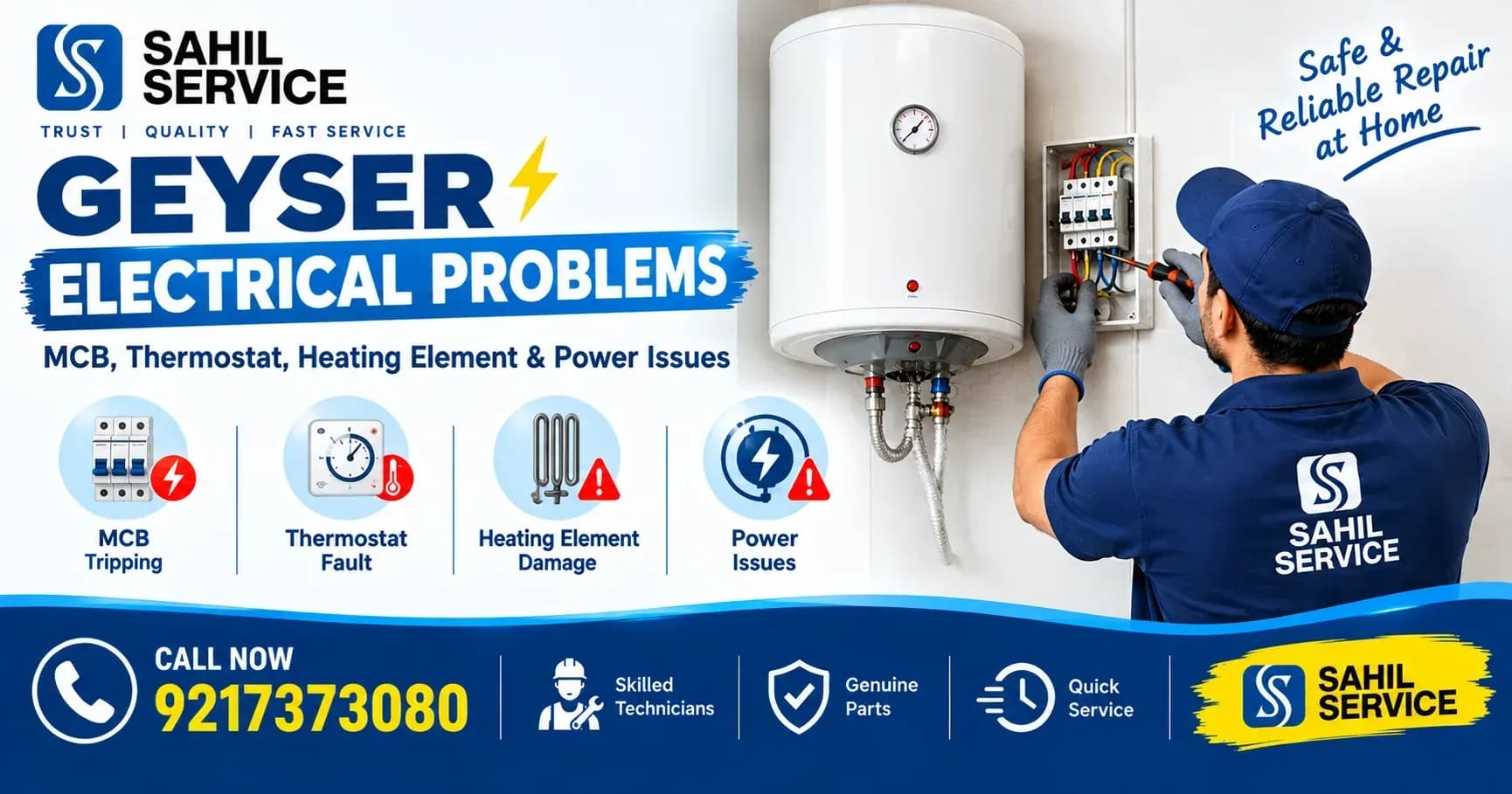
When water and electricity share the same metal box, there’s zero room for guesswork. When everything is running smoothly, you flick a switch, hear the quiet hum of water warming up, and go about your morning. But the moment a geyser starts throwing breaker switches, refusing to turn on, or—worst of all—delivering a sudden tingle through the shower tap, it demands immediate attention.
Electrical issues in water heaters are surprisingly common. Between high wattage demands, constant heating-and-cooling cycles, and moisture creeping into internal housings, components naturally wear down over time.
The trick is knowing when a problem is a minor annoyance—like a burnt-out bulb—and when it's a critical safety warning telling you to step away from the switch. Here is a breakdown of what happens behind the casing and how to navigate these electrical hiccups safely.
Why does my geyser keep tripping the MCB?
If your home’s Miniature Circuit Breaker (MCB) snaps off the second your geyser kicks in, your electrical panel is doing its job: preventing a potential electrical fire or severe shock.
An MCB trips when it detects either a sudden power surge (short circuit) or an unsafe draw of electrical current. In a geyser, the most common triggers are:
- A fractured heating element: Over time, the outer sheath of the heating element can crack due to mineral corrosion, allowing water to come into direct contact with the live internal resistance wire.
- Moisture in the terminal box: Steam or minor leaks creeping into the lower electrical panel cause a short between live and neutral wires.
- Degraded or melted wiring: Loose wire connections heat up, melt their insulation, and touch the metal body of the geyser.
- An overloaded breaker: If your geyser is sharing a circuit line with other high-wattage appliances (like a washing machine or room heater), the combined draw exceeds the MCB’s amperage rating.
Rule of thumb: If the MCB trips once, you can reset it once to rule out a temporary grid spike. If it trips a second time, leave it off. Continuously forcing a tripped breaker back on can overheat your home's internal wall wiring.
Why does the geyser switch trip when I turn it on?
When the trip is instantaneous—meaning the switch or breaker snaps the exact millisecond you turn it on—you are almost certainly dealing with a direct short-to-ground or dead short circuit.
This immediate reaction happens because electricity is finding a shortcut to the earth wire or the metal body of the appliance rather than passing safely through the heating element's resistor.
Common causes for instantaneous tripping include:
- A completely shorted heating element where internal insulation has collapsed.
- A fried thermostat where internal contacts have welded together or shorted against the casing.
- Water dripping directly onto the open wiring connections behind the front cover.
- A failed, charred wall socket or switch terminal.
Keep the appliance turned off at the main board until a technician can put a multimeter to the unit and isolate the short.
Why is my geyser not getting power?
You turn on the wall switch, but nothing happens. No indicator lights, no soft hum, and no hot water an hour later.
Before assuming the worst about the appliance itself, run through a simple elimination process:
- Check the main switchboard: Look for a tripped MCB or Residual Current Circuit Breaker (RCCB/ELCB) specifically linked to the bathroom line.
- Inspect the wall outlet: Geysers draw significant power (2000W–3000W) and require dedicated 16-Amp heavy-duty sockets. Standard switches often overheat, char internal contacts, and melt quietly behind the cover plate without any obvious external damage.
- Verify internal thermal cut-outs: Many modern geysers have an internal reset button attached to the safety thermostat. If the unit overheated recently, this safety button may have popped out, cutting all incoming power to protect the heating coil.
If the wall socket has power but the geyser remains completely lifeless, the internal thermal fuse or main wiring harness needs inspection.
Why is my geyser indicator light not working?
A dark indicator light can be alarming, but it doesn't always mean your geyser is completely dead.
Most storage geysers have two small indicator lights:
- Power Light (usually Red/Orange): Shows that electricity is reaching the unit from the wall socket.
- Heating Light (usually Green): Signals that the thermostat is actively sending current through the heating element.
If the green light turns off while the red light stays on, that’s standard operation—it simply means the water has reached the target temperature and the thermostat has temporarily cut the heating element.
However, if the light bulb itself burns out, the geyser may continue to heat water perfectly fine in total darkness. The simplest test is to leave the switch on for 15 minutes; if the water coming from the tap gets hot, you only have a blown 20–50 INR neon/LED indicator bulb to swap out at your convenience. If the water stays cold, the dark light points to a broader power loss or thermostat failure.
Why does my geyser turn off automatically?
Automatic shut-off is actually a key safety feature of every modern water heater, but when and how often it turns off makes all the difference.
Under normal conditions, once the water in the storage tank hits your selected temperature (usually set around 50∘C–60∘C), the primary thermostat opens its contacts, shutting off power to the element. Once you draw hot water and cold water refilling the tank drops the overall temperature, the thermostat closes the circuit again, restarting the heat cycle.
When automatic shut-off becomes a fault: If the unit shuts off after only two or three minutes—leaving you with lukewarm or cold water—the thermostat calibration has likely drifted, or the sensor tube inside the tank is thick with mineral scale. The scale traps heat around the sensor, tricking the thermostat into thinking the whole tank is boiling when only a few liters near the element have warmed up.
What causes a geyser thermostat to fail?
The thermostat acts as the brain of your geyser, monitoring tank temperatures and controlling power flow. Because it continuously clicks open and closed under heavy electrical loads, it is subject to mechanical and electrical wear over time.
Primary causes of thermostat failure include:
- Arcing and contact wear: Every time the thermostat snaps open or shut, a tiny electrical arc occurs. Over thousands of cycles, these copper contacts pit, corrode, or weld themselves shut.
- Voltage fluctuations: Unstable power grids with sudden voltage spikes can scorch delicate bi-metallic strips or internal sensor coils.
- Corrosion and moisture: High humidity levels in bathrooms slowly corrode the external adjustment dials and internal spring mechanisms.
A failing thermostat will manifest in extremes: either cutting power far too early (giving you lukewarm water) or refusing to cut power at all (causing extreme overheating and steam build-up).
What happens when a geyser heating element burns out?
The heating element is the heavy-lifter of the system—a metal tube containing a resistive heating wire surrounded by insulating powder.
When a heating element "burns out," that internal resistance wire breaks or melts, completely severing the electrical path.
What you will experience:
- The geyser may still draw power, and indicator lights may glow normally, but the water will stay completely cold no matter how long you leave it running.
- If the burnt wire inside touches the outer sheath as it breaks, it creates a direct earth fault, causing your home’s MCB or RCCB to trip immediately whenever the switch is flipped.
- Once a heating element’s coil is severed, it cannot be repaired or re-welded. It must be unbolted and replaced with a new element matched to your geyser's capacity and wattage rating.
How do I know if my geyser heating element is damaged?
Because the element lives hidden deep inside the water tank, you can't visually inspect it without dismantling the appliance. However, a few clear symptoms signal that the element is on its last legs:
Get Heating Element Inspection
- Drastic drop in heating speed: Water takes twice or thrice as long to warm up as it did a few months ago.
- Sizzling or humming noises: A heavy layer of hard-water scale on the element causes trapped water beneath the crust to boil violently, producing a loud hissing or popping sound inside the tank.
- Tripping breakers: Flipping the geyser switch instantly trips your MCB/RCCB.
- Water stays cold despite active power lights: Power reaches the unit, but heat transfer has completely stopped.
A technician can definitively test an element in 30 seconds using a digital multimeter set to measure resistance (ohms) across the element's terminals.
Why does my geyser overheat?
When steam starts sputtering out of your hot water tap alongside scalding hot water, your geyser is in an dangerous state of overheating.
This happens when the primary temperature regulation system fails completely. The thermostat contacts weld shut or fail to sense rising temperatures, leaving the heating element powered on continuously.
The backup safety net: When the primary thermostat fails to cut power, the temperature will rise past 80∘C, triggering the Thermal Cut-out Switch (or high-limit safety reset). This secondary safety switch physically breaks the circuit to prevent the water from turning entirely to steam and rupturing the tank.
If your geyser produces scalding hot water or requires you to manually press a reset button inside the cover panel to get it working again, do not continue using it without replacing the faulty primary thermostat.
Why does my geyser give an electric shock?
Feeling a tingle, buzz, or sharp shock when touching the tap water, shower head, or metal casing of a geyser is a red-alert safety emergency.
An electric shock occurs because live current is leaking into the water supply or the outer metal shell, and your body is acting as the path to the ground.
Common causes include:
- A cracked heating element: Current passes directly from the exposed internal wire into the water inside the tank.
- Missing or corroded earthing (grounding): If your home’s earthing wire is loose, disconnected, or non-existent, leaked voltage cannot drain safely into the ground, leaving the metal pipes fully energized.
- Melted wire touching the tank body: Damaged internal insulation causing a live wire to press directly against the inner shell.
- Water leaking over live electrical terminals: Internal leaks dripping onto switch nodes or thermostat posts.
Immediate Action Required: If you feel even the slightest electric shock, turn off the geyser power switch immediately using a dry cloth or plastic tool if the switch plate is damp. Do not use the shower or taps until an electrician has verified the grounding and inspected the appliance.
What Should You Do If Your Geyser Has an Electrical Problem?
When handling potential electrical faults in high-wattage wet appliances, caution is your best friend.
Follow these simple safety guidelines:
- Turn off power at the source: Flip the main breaker OFF before attempting to examine or wipe down a wet or malfunctioning geyser.
- Stop flipping tripped breakers: If the MCB snaps off twice, leave it off until the underlying cause is diagnosed.
- Never open electrical covers yourself: The lower panel of a geyser houses exposed high-voltage terminals (220V–240V) that retain current and pose severe shock hazards.
- Don't bypass safety features: Never remove an earth wire, wire around a tripped thermal cut-out, or fuse an MCB line to keep a broken geyser running.
- Book a professional check: Isolate the fault using proper diagnostic tools like multimeters and megohmmeters.
Geyser Repair and Service in Delhi
Dealing with an MCB that won't stay up, a dark power light, cold water, or suspecting a dangerous electrical leak? Sahil Service offers prompt, professional, doorstep geyser repair across Delhi and nearby NCR regions.
When high voltage and water are involved, guessing isn't an option. Trained technicians arrive at your home with proper testing tools to isolate the exact electrical short, test heating coil resistance, and replace faulty parts safely.
Sahil Service resolves all major electrical and heating issues:
- MCB and RCCB tripping diagnostics
- Heating element testing, descaling, and replacement
- Thermostat testing, adjustment, and replacement
- Thermal cut-out safety resets and swaps
- Internal terminal box re-wiring and insulation repairs
- Indicator light and power switch repairs
- Appliance earthing and voltage leakage checks
- Full annual safety and performance servicing
Why Choose Sahil Service?
Handling appliance electrical faults requires expertise, correct replacement components, and transparent service.
With Sahil Service, you get:
- Doorstep convenience: No need to dismantle or carry heavy water heaters across town.
- Delhi-wide coverage: Quick response times across Delhi and adjacent NCR neighborhoods.
- Accurate diagnostics: Thorough testing of wiring, thermostats, and elements before suggesting part replacements.
- Clear, upfront communication: Full explanation of the fault and cost estimates provided before any work starts.
- Safety-first repairs: Genuine, factory-rated replacement parts fitted according to strict electrical safety standards.
Final Thoughts
An electrical issue with your geyser—whether it’s a minor nuisance like a dead indicator light or a serious hazard like an MCB that constantly trips—is your appliance’s way of asking for help.
Ignoring these signs or repeatedly forcing a tripped breaker back on can turn a small, inexpensive component swap into major wiring damage or a genuine safety hazard.
If your geyser is showing electrical strain anywhere in Delhi or nearby areas, contact Sahil Service to book a safe, hassle-free doorstep inspection today.