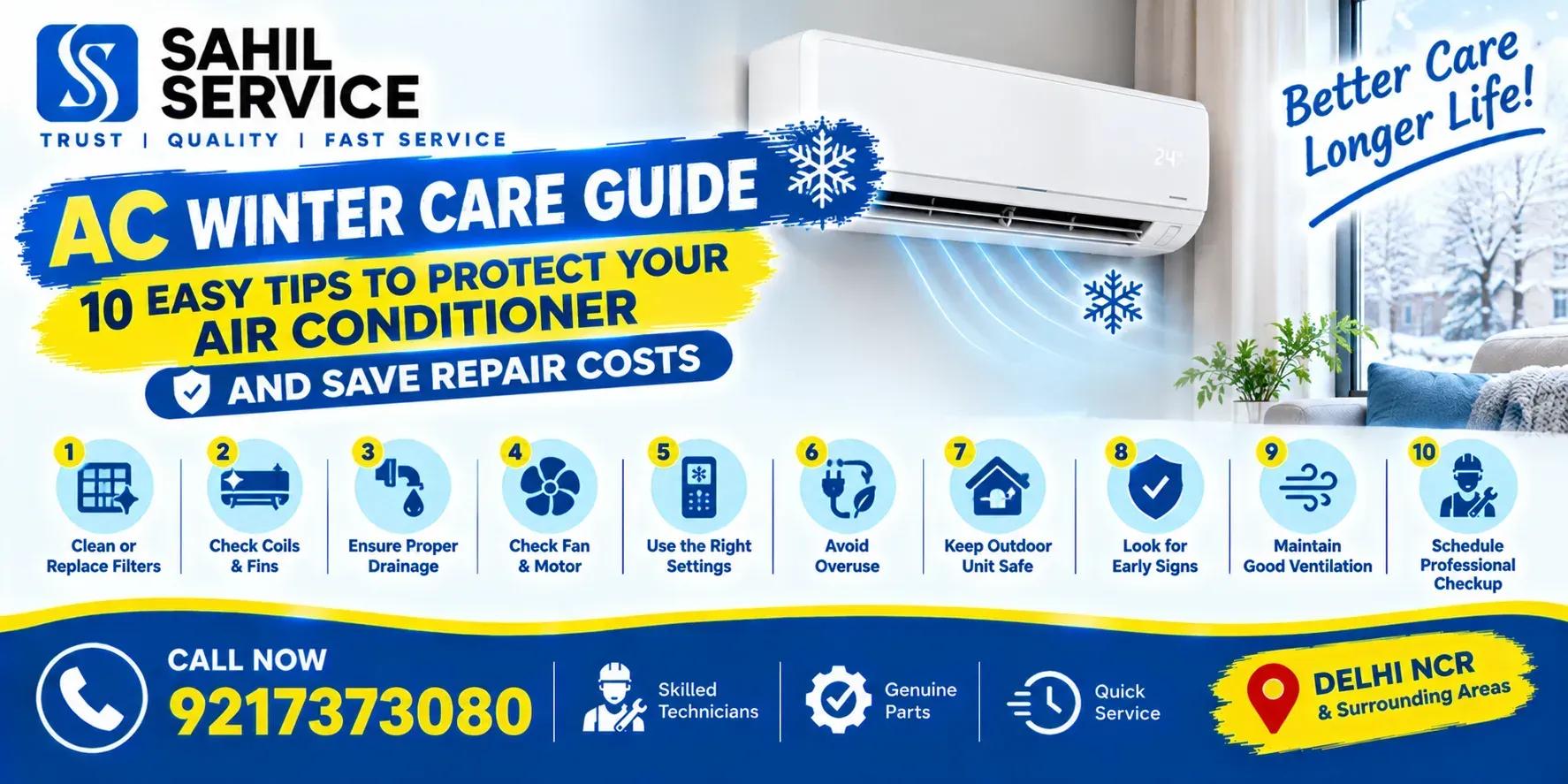
AC Winter Care Guide: 10 Easy Tips to Protect Your Air Conditioner and Save Repair Costs
Learn 10 easy AC winter care tips to prevent damage, reduce maintenance costs and prepare your air conditioner for summer. Book expert AC service with Sahil Service
When winter arrives, most people in India stop using their air conditioners. The AC remote goes into a drawer, the outdoor unit gets ignored, and nobody thinks about maintenance until the first hot day of summer.
Then suddenly, the AC starts making strange noises, cooling becomes weak, or water begins dripping from the indoor unit. What should have been a simple maintenance job can turn into an unexpected repair expense.
If this sounds familiar, you are not alone.
Whether you have a split AC in your bedroom, a window AC in your living room, or multiple air conditioners in your office, winter is a good time to give them some attention.
The good news? You do not need to run your AC throughout winter to keep it in good condition. A few simple precautions can help protect your air conditioner while it is not in regular use.
In this guide, we will explain 10 practical AC winter care tips, common mistakes to avoid, and when professional AC servicing from Sahil Service may be helpful.
Why Is AC Winter Maintenance Important?
During winter, an air conditioner may remain unused for several weeks or months. Meanwhile, dust can accumulate on the filters and outdoor unit, and the equipment may be exposed to rain, moisture, or changing temperatures.
Ignoring these things does not automatically mean your AC will develop a problem. However, basic maintenance can help you identify issues early and prepare the system for the next cooling season.
Here is why winter AC care is worth considering:
- It helps keep dust from building up on accessible filters and surfaces.
- It gives you an opportunity to identify visible damage or loose covers.
- It helps you notice unusual smells, leaks, or signs of wear before summer.
- It can reduce the risk of starting the cooling season with an unresolved problem.
- It gives you time to arrange servicing before technicians become busy during peak summer.
Think of winter as an opportunity to prepare your AC rather than waiting for it to stop working when you need it most.
10 AC Winter Care Tips Every Homeowner Should Follow
1. Turn Off Your AC Properly When the Weather Gets Cold
If you have a conventional cooling-only air conditioner and no longer need it, switch it off using the remote and follow the manufacturer's instructions for shutting it down.
If your AC has a dedicated power switch or isolator, use it according to the manufacturer's safety guidance. Do not handle electrical connections with wet hands or open electrical panels yourself.
For an inverter AC, there is no need to keep running the cooling mode simply because it is an inverter model. Inverter technology adjusts compressor operation, but it does not eliminate the need for maintenance.
Helpful tip: If your AC has a heating mode, it may be a heat-pump model. Follow the manual for its heating operation rather than treating it like a cooling-only unit.
2. Clean the AC Filters Before Storing It for Winter
One of the easiest AC maintenance tasks is cleaning the indoor unit's air filters.
Filters collect dust, hair, and other airborne particles during normal operation. When they become clogged, airflow can decrease, and the system may have to work harder to deliver the desired cooling.
Here is what you can do:
- Switch off the AC before opening the filter compartment.
- Remove the filters as instructed in the user manual.
- Clean them using the method recommended by the manufacturer.
- Allow washable filters to dry completely before reinstalling them.
- Close the panel properly before using the AC again.
Never operate the AC with wet filters or spray water into electrical components.
If the filters are damaged or the indoor unit needs deeper cleaning, consider professional servicing instead of attempting a complicated cleaning job yourself.
3. Protect the Outdoor AC Unit From Rain, Dust and Debris
Your outdoor unit is exposed to the elements throughout the year. During winter, falling leaves, dust, rain and other debris may collect around it.
Start by checking the area around the unit. Remove loose leaves and objects that could obstruct airflow, provided they can be removed safely from the ground.
You should also check that the unit's drainage arrangements are not visibly blocked and that its supporting structure appears stable.
Should you cover your outdoor AC unit in winter?
A breathable, manufacturer-approved cover may be suitable for certain units when they are not being used. However, covering is not necessary for every model.
If you use a cover:
- Follow the manufacturer's instructions.
- Avoid wrapping the unit in airtight plastic.
- Do not block ventilation openings when the unit is operating.
- Secure the cover so it cannot become loose in strong winds.
- Never place a cover over a running unit.
Do not climb onto ledges or balconies to reach an outdoor unit. If access is difficult, ask a professional technician to inspect it.
4. Avoid Switching On the AC Just to Test It
A common question is whether an AC should be switched on occasionally during winter.
The answer depends on the model and the manufacturer's instructions. You should not run a cooling-only AC when outdoor temperatures are outside its permitted operating range.
Low outdoor temperatures can affect refrigerant pressures and compressor operation. Some systems have specific temperature limits, while others include features designed for colder conditions.
If you want to test your AC after a long period of inactivity, first check the operating instructions.
If the system needs a professional inspection, a technician can assess whether it is suitable to operate under the current conditions.
5. Keep the Indoor Unit Clean and Dry
The indoor unit can collect dust even when it is not running.
Use a soft, dry cloth to wipe the accessible exterior of the AC. Keep the surrounding wall and area reasonably clean, and avoid spraying household cleaners directly into the unit.
If you previously noticed a musty smell, water leakage, or visible dirt around the vents, winter can be a convenient time to arrange a more thorough inspection.
Do not dismantle the blower, cooling coil, or electrical components unless you are qualified to do so.
Professional cleaning may be appropriate when dirt has accumulated inside areas that are not safely accessible to homeowners.
6. Check for Signs of Water Leakage or Physical Damage
Before leaving your AC unused for the season, check for visible signs of trouble.
Look for:
- Water stains on the wall below the indoor unit.
- Damaged insulation around accessible refrigerant piping.
- Loose or damaged covers.
- Unusual corrosion or physical damage on visible components.
- Signs of water collecting where it should not.
Water leakage can have several causes, including drainage problems, installation issues, or coil icing during operation. It is not always caused by a blocked drainpipe.
If you notice damage, arrange an inspection before using the AC again. Do not attempt to repair refrigerant lines or electrical components yourself.
7. Do Not Get AC Gas Refilled Without a Proper Diagnosis
Some homeowners believe that every air conditioner needs a gas refill before summer. This is a common misconception.
An AC operates with refrigerant circulating through a closed system. Under normal conditions, it should not need routine refrigerant top-ups simply because winter has arrived.
If refrigerant is low, a leak or another system problem may be responsible. Adding refrigerant without investigating the cause may not solve the underlying issue.
If your AC showed weak cooling, repeated icing, or other unusual symptoms before winter, have it checked by a qualified technician.
A proper inspection may include leak detection, diagnosis of the cooling problem, and refrigerant checks where appropriate.
At Sahil Service, homeowners can explore AC repair, cooling-problem diagnosis and gas refill services when professional attention is needed.
8. Inspect the Remote Control and Electrical Supply
Small problems can become frustrating when you first try to use the AC in summer.
Check whether the remote has working batteries and whether its buttons function correctly. If the remote uses replaceable batteries, remove them during long storage if recommended by the manufacturer.
You can also look for visible damage to accessible cables, plugs, or switches without opening any electrical equipment.
Never use an AC with exposed wiring, burnt smells, damaged plugs, or signs of electrical overheating.
If the system does not power on, trips a circuit breaker repeatedly, or makes an electrical buzzing sound, switch it off and arrange professional help.
9. Schedule AC Servicing Before the Summer Rush
Many people wait until temperatures rise before booking AC maintenance. By that time, service appointments may be harder to arrange, especially during a heatwave.
Winter or early spring can be a convenient time to plan an inspection, particularly if your AC was used heavily last summer.
Depending on the unit's condition, age, usage and manufacturer's maintenance schedule, a professional service may involve:
- Checking and cleaning accessible filters.
- Inspecting the indoor unit and airflow.
- Examining the outdoor unit for visible dirt or damage.
- Checking drainage and signs of leakage.
- Inspecting relevant electrical connections and operating components.
- Diagnosing cooling performance where operating conditions permit.
Not every AC needs the same level of service. A technician should recommend work based on the equipment's actual condition rather than assuming every component requires cleaning or replacement.
Sahil Service offers AC servicing, foam-jet cleaning, repair, installation and other maintenance services across Delhi NCR.
10. Prepare a Simple AC Maintenance Checklist for Summer
Before the first hot spell arrives, take a few minutes to review your AC's condition.
Here is a simple checklist you can save for later.
- Clean the accessible air filters.
- Check the indoor unit for visible dust and damage.
- Keep the area around the outdoor unit clear.
- Check for visible water stains or damaged insulation.
- Check the remote control and batteries.
- Review the manufacturer's instructions before restarting the AC.
- Arrange professional servicing if the AC had problems last season.
- Test the system only when outdoor temperatures and operating conditions are within the manufacturer's permitted range.
If your AC worked properly last season and has no visible issues, you may only need routine maintenance. If you noticed poor cooling, unusual noise, repeated leakage, or electrical problems, arrange a professional inspection before relying on it again.
Split AC vs Window AC: Are Winter Care Requirements Different?
Both split ACs and window ACs need sensible off-season care, but their installation and construction differ.
| Maintenance task | Split AC | Window AC |
|---|---|---|
| Clean accessible air filters | Yes | Yes |
| Keep the exterior clean | Yes | Yes |
| Check for visible damage | Indoor and outdoor units | Front panel, casing and accessible exterior |
| Protect from rain and debris | Keep outdoor unit area clear | Check exposure and installation condition |
| Check for drainage issues | Inspect for visible leakage | Inspect for visible leakage |
| Professional inspection | When needed | When needed |
The same basic principle applies to both: clean what you can access safely, follow the user manual, and leave electrical or refrigerant-related work to qualified technicians.
Common AC Winter Care Mistakes to Avoid
Even with good intentions, homeowners sometimes make mistakes that can create unnecessary problems.
Wrapping the outdoor unit completely in plastic
An airtight covering can trap moisture and may obstruct ventilation if left in place during operation. Follow the manufacturer's recommendations for any protective cover.
Refilling AC gas every winter
Refrigerant does not normally need routine replacement each winter. Have the system diagnosed if you suspect a leak or cooling problem.
Ignoring last season's cooling problems
If the AC struggled to cool in summer, leaving it unused will not fix the underlying problem. Arrange a diagnosis before the next cooling season.
Washing the AC yourself with excessive water
Water entering electrical components can create serious risks. Basic filter cleaning is different from deep cleaning the blower or cooling coil.
Waiting until the first heatwave to book a service
Planning ahead gives you more flexibility to arrange maintenance before demand increases.
When Should You Book Professional AC Service?
Basic maintenance is useful, but certain problems require a trained technician.
Consider booking an inspection if you notice:
- The AC was not cooling properly before winter.
- Water repeatedly leaked from the indoor unit.
- The AC produced unusual noises or persistent unpleasant smells.
- The circuit breaker tripped repeatedly during operation.
- Ice formed on the coil or refrigerant pipes.
- The outdoor unit appeared damaged.
- The system has not been serviced for a long time and shows signs of poor performance.
Do not ignore electrical burning smells, damaged wiring, or repeated circuit-breaker trips. Stop using the system and arrange qualified assistance.
How Sahil Service Can Help With Your AC Winter Care
Taking care of an AC is easier when you know which tasks you can handle yourself and which ones need professional attention.
Sahil Service provides home appliance repair and maintenance services across Delhi, Noida, Greater Noida, Ghaziabad, Gurugram and Faridabad.
If your AC needs attention before the next summer, you can explore services such as:
AC servicing and cleaning: Routine maintenance and cleaning to address accumulated dirt and airflow concerns.
Foam-jet AC cleaning: A professional cleaning option for suitable units when deeper cleaning is needed.
AC repair: Assistance with cooling issues, unusual noises, water leakage and other diagnosed faults.
AC gas refill and leak checks: Refrigerant-related service when inspection indicates that it is necessary.
AC installation and uninstallation: Professional assistance when moving, replacing or installing an air conditioner.
Why consider Sahil Service?
- Experienced technicians for AC and other home appliances.
- Doorstep service across Delhi NCR.
- Transparent pricing and recommendations based on the reported problem.
- Same-day service availability where scheduling permits.
- A stated 30-day service warranty on applicable work, subject to the service terms.
You do not need to wait for your AC to stop working completely before seeking help.
Need professional AC maintenance? Visit Sahil Service AC Services to explore available options and book the service you need.
Frequently Asked Questions About AC Winter Care
1. Should I cover my AC outdoor unit in winter?
Not necessarily. Follow the manufacturer's guidance for your particular model. If a cover is recommended, use a suitable cover that does not trap moisture or obstruct ventilation during operation.
2. Should I switch on my AC during winter?
You do not need to run a cooling-only AC just to keep it healthy. Operate it only within the temperature limits and conditions specified by the manufacturer. Heat-pump models may have different operating instructions.
3. How do I maintain my AC when it is not being used?
Clean the accessible filters, wipe the exterior, keep the outdoor unit area clear, and check for visible damage or leakage. Arrange professional servicing if you notice a problem or if maintenance is due.
4. Is AC servicing necessary before summer?
It is useful when maintenance is due, the AC has not been serviced according to the manufacturer's schedule, or problems occurred during the previous season. The amount of work required depends on the system's condition.
5. Does an AC need a gas refill after winter?
No. Refrigerant does not normally need to be refilled simply because the AC has been unused during winter. If cooling performance is poor, a technician should diagnose the cause before adding refrigerant.
6. Can I clean my split AC outdoor unit myself?
You can remove loose debris from the surrounding area when it is safely accessible. Do not climb to reach the unit, open electrical compartments, or use excessive water or pressure. Leave detailed cleaning and repairs to a qualified professional.
7. What should I do if my AC smells bad when I switch it on after winter?
Switch it off if the smell is strong, unusual, or resembles burning. A musty smell may indicate moisture or dirt, while a burning smell could signal an electrical problem. Have the cause checked before continuing to use the system.
8. How often should AC filters be cleaned?
Follow your manufacturer's instructions and adjust the frequency according to dust levels, usage and indoor conditions. Filters may need more frequent cleaning in dusty environments.
9. Can winter maintenance reduce AC electricity consumption?
Keeping filters clean and ensuring the system is maintained properly can support efficient operation. However, actual electricity consumption depends on the AC model, room conditions, temperature settings, usage and any underlying faults.
10. Where can I book AC servicing in Delhi NCR?
You can visit Sahil Service to explore AC servicing, cleaning, repairs and other available services across Delhi NCR.
Final Thoughts
Your air conditioner may be taking a break during winter, but a little maintenance now can make the next cooling season easier.
Clean the filters, keep the outdoor unit area clear, look for visible signs of damage, and avoid unnecessary repairs or refrigerant refills. If your AC had cooling issues or other faults last summer, arrange an inspection before temperatures rise.
And remember, not every AC requires an extensive service just because winter has arrived. The right maintenance depends on your unit's condition and the manufacturer's recommendations.
If your AC needs professional care, Sahil Service is here to help with AC cleaning, servicing, repair and maintenance across Delhi NCR.